One of the more recently-married ICA couples graduated together in 1994, following two full years of dating, ICA-style.
From the
beginning of her junior year, Laura Hill liked Brad Lobb right away.
"I was attracted to Brad because I thought he was the best looking guy
I had ever seen. Also he was a 'tough' guy, which wasn't my usual
type. I guess 'the forbidden' attracted me! But as tough as
he was, he was so nice and such a gentleman. We kept flirting with each
other," she remembers, "but I vowed not to get involved."
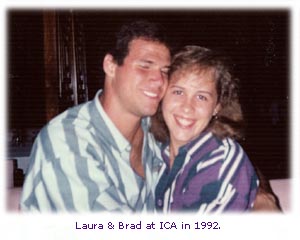
Brad recognized something special in the way Laura treated him and others.
"I was attracted to the way she looked I thought she was very beautiful,"
he says. "We shared common interests and found the same things humorous."
Brad's dormfather in Beth-Eden was Pops Eash. Matt Boles, a fellow classmate, bet that Brad and Laura wouldn't get together, but Pops bet that they would.
"One night after about 2 weeks, we were talking about the bet," Laura said. "Brad asked me who I wanted to win. I shyly admitted: 'Pops' and Brad replied: 'me too'."
This was the beginning of an official couple, but in 1992, ICA had changed its dating rules. Gone was the old standard of naming couples, and the "third" rule was introduced in its stead. Couples were allowed to be with each other most of the time as long as they were accompanied by a third person. Brad and Laura referred to it as the "Third Wheel Rule". There were ways around that of course: just get with another couple and "double date", or otherwise ignore each other, Laura says. The Lobbs remember that they were able to have exclusive time every Saturday and Sunday night, and Sunday afternoon.
Of course, there was the six inches apart rule, and the absolutely-no-physical contact rule. Brad calls the rule "strict and unflexible," but it didn't keep them apart, with Brad admitting that they broke the rules "on a regular basis".
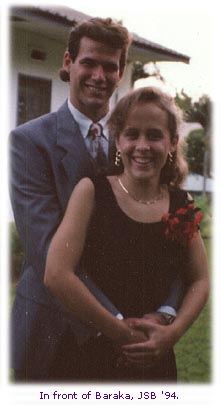
"Who didn't?" asks Laura. "We stole kisses in the commissary, hugs on Baraka's front porch, held hands in the park. And on dates to town, ICA rules were forgotten. We got caught of course. For our very first kiss, someone snitched and we were hauled before the DC [discipline committee] and got 13 weeks of no contact (eye, physical, notes, word of mouth) among other things."
 Laura
thinks that their ICA friends expected them to get married and consider
it pretty neat that they did. Brad says "Our ICA friends who have
seen us have all been comfortable with us and have seen a real love between
us. Other people think we complement one another and make an impact on
those around us. Our family is supportive and encouraging.
We enjoy close relationships with both sets of parents as well as my siblings
and their
Laura
thinks that their ICA friends expected them to get married and consider
it pretty neat that they did. Brad says "Our ICA friends who have
seen us have all been comfortable with us and have seen a real love between
us. Other people think we complement one another and make an impact on
those around us. Our family is supportive and encouraging.
We enjoy close relationships with both sets of parents as well as my siblings
and their
spouses and Laura's brother."
Laura's younger brother John attended ICA at the same time as Laura, whose parents worked in Burkina Faso with the Southern Baptists. "We are affectionate and yet both very strongwilled. I don't think my parents were thrilled when we started dating," Laura says, "but I know they approve now."
And how did dating at ICA prepare them for their life together? Laura thinks the extent of the rules was unnatural. "There is nothing wrong with couples being able to express their feelings for one another and be able to hold hands or hug without being treated as the worst person who ever walked the earth. Rules are good to a degree, but some things are better allowed."
"Rules are necessary," Brad says, "but kids like us need to be allowed to express some of their natural instincts and treated as being normal and not have to sneak around."
Another danger is the sudden freedom that exists in the "real world", whatever that is, Laura says. "Our peers are generally out of control and the freedom we suddenly have is too much and a lot of people get in trouble. I think there would be real value in ICA teaching kids limits by allowing a little bit of the freedom they will eventually face and not just pretending it doesn't exist."
Brad doesn't blame ICA completely for some of the trouble kids get into when they get out in the world, but he believes more could be done to better prepare them. Laura also says that during her time at ICA, some of the staff were more judgemental than supportive of her. "I confided in a few and I was really hurt by the treatment I got. I knew the answers, but I just wanted reassurance." This led to her eventually refusing to say anything to anyone about her relationship with Brad. She felt that not many people approved of their relationship. "I am so glad I didn't listen," Laura concludes. "I would have missed out on being married to my best friend in the world."
Brad's experience
was more positive. "I confided in a few staff members. Most
people I talked to were quite supportive and taught me the reasons behind
staying pure. They are the reason I made a personal decision to
stay pure with Laura until we got married."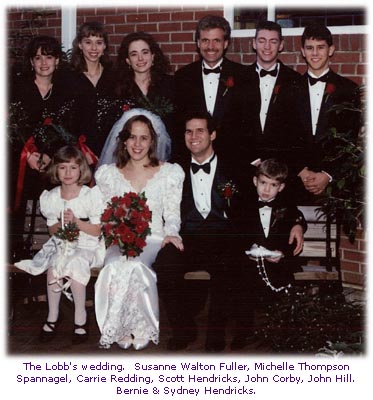
Brad is a Canadian, so his parents travelled from Canada to South Carolina for Brad and Laura's wedding a year and a half after graduation from ICA. The Lobbs married at Christmas time and had a beautiful ceremony with the hall decorated in poinsettias, Christmas wreaths and lights. Laura came up the aisle to the Star-Spangled Banner, and they left together to the rousing strains of O Canada. Laura says that the attempt to mesh American and Canadian traditions competely frazzled their wedding coordinator. Brad also remembers that he was in the middle of school and Laura's parents were due back in Africa, which made the wedding a hectic affair. "Nonetheless," he says, "it was very special and a meaningful time."
Brad says the neatest thing about their wedding was the many ICA friends who were involved. Most of the class of 94 were able to make it. Except for the maid of honor, the whole wedding party consisted of ICAers. They had Clint Morgan (father of Adam, '94) perform the ceremony. Scott Hendricks (staff) was Brad's best man. The ushers and singers were ICAers. All were staying at the same hotel and took up a whole section of a restaurant for a reunion party the night before the ceremony.
Laura says
that ICA is "hard to get out of your blood", and the Lobbs have talked
about going back to ICA. "We both feel we gained a lot from our
experiences at ICA," Brad says. "We believe ICA plays a large role
in developing lives of young people and we identify with some of the difficulties
they face growing up in a different culture and trying to become Godly
young men and women before returning to a culture that is less than Godly.
I believe that if the Lord calls me overseas, a ministry such as ICA or
a support ministry of some sort is the area in which he would want me."
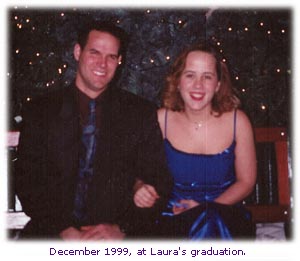
Laura's currently finishing up a degree in Occupational Therapy.
Brad is working as a cabinet maker/carpenter. For now they plan
to settle in Calgary, Alberta and work, starting a family in a year or
so. "We're not yet sure what the Lord has in mind for us," Brad
says. "Both of us continue to strive to develop our skills and talents
to be able to be used by Him in whatever He leads us to."